
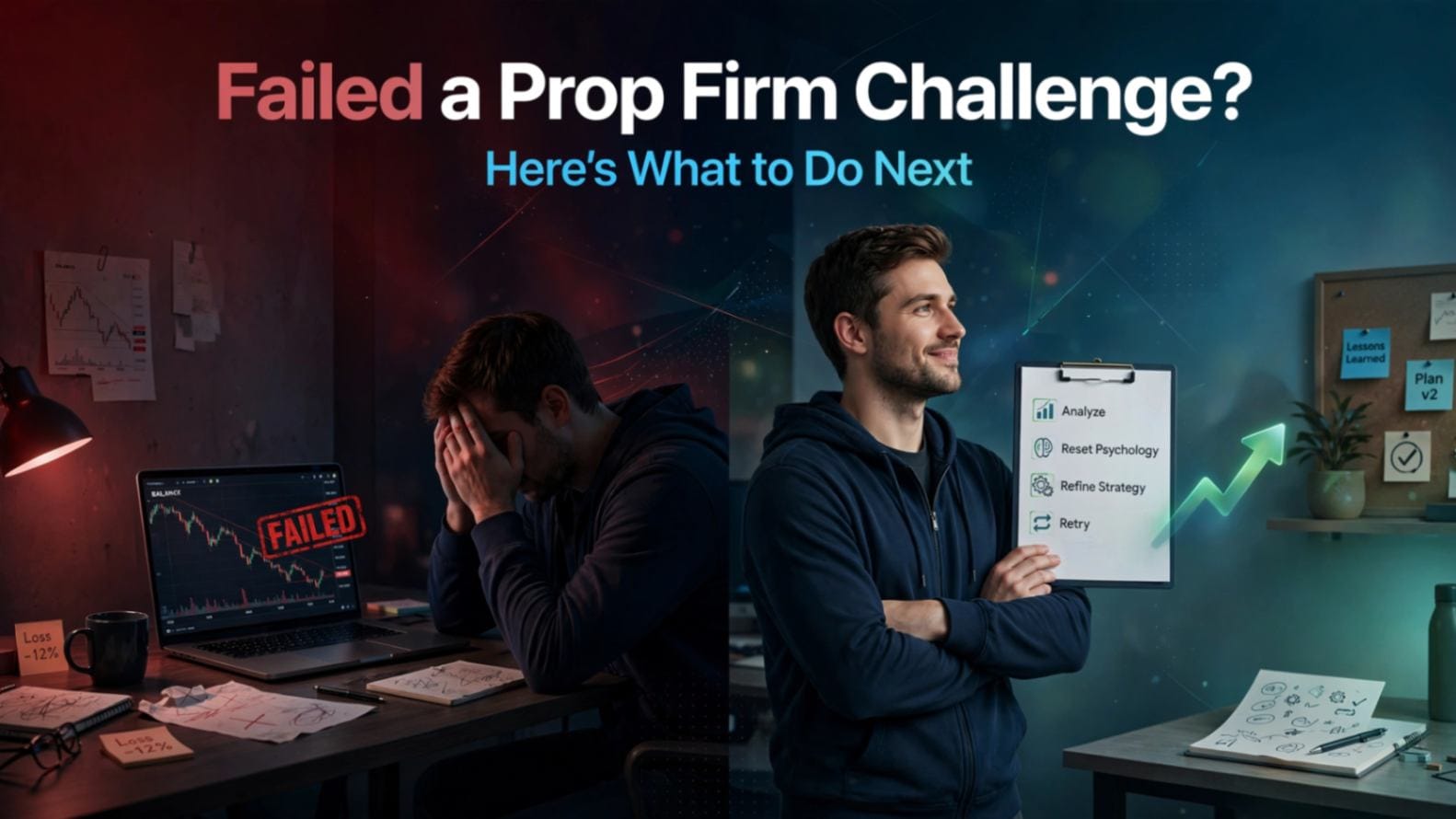
Failing a prop firm challenge can be frustrating.
You spend days or even weeks analyzing charts, following market movements, and trying to reach the profit target, only to see the account fail due to a drawdown violation, poor decision, or a series of losing trades.
If you've recently failed a prop firm challenge, you're not alone.
Thousands of traders fail evaluations every year. In fact, challenge failures are far more common than most traders realize. The important thing is not the failure itself, it's what you do next.
Many traders immediately purchase another challenge without understanding why the first one failed. As a result, they repeat the same mistakes and lose even more money.
In this guide, we'll explain what to do after failing a prop firm challenge, how to avoid making the same mistakes again, and how to improve your chances of success moving forward.
What to Do Next if you Failed a Prop Firm Challenge
Don't Rush Into Another Challenge
One of the biggest mistakes traders make is buying a new challenge immediately after failing one.
This reaction is often driven by emotion rather than logic.
Common thoughts include:
- “I'll recover on the next one.”
- “I was just unlucky.”
- “I only need one more chance.”
- “This time will be different.”
Unfortunately, if the underlying problem hasn't been addressed, the outcome is often the same.
Before purchasing another challenge, take time to analyze what happened.
Identify Why You Failed
Every challenge failure has a cause.
Understanding that cause is the first step toward improvement.
Ask yourself:
Did You Violate a Drawdown Rule?
Many traders fail because they exceed:
- Daily loss limits
- Maximum account drawdown limits
If this happened, your risk management may need improvement.
Did You Overtrade?
Taking too many trades often leads to unnecessary losses.
Ask yourself:
- Was every trade part of your strategy?
- Were you trading out of boredom?
- Were you forcing opportunities?
Did Emotions Affect Your Decisions?
Emotional trading remains one of the biggest reasons traders fail evaluations.
Examples include:
- Revenge trading
- Fear of missing out (FOMO)
- Greed
- Fear-based exits
Did You Ignore Your Trading Plan?
Many traders have a plan but fail to follow it consistently.
If you ignored your strategy during the challenge, discipline may be the issue rather than the strategy itself.
Review Your Trading Journal
If you maintain a trading journal, now is the time to review it.
Look for patterns such as:
- Frequent rule violations
- Poor entries
- Excessive risk per trade
- Emotional decisions
- Inconsistent execution
The goal is to identify recurring mistakes.
If you don't keep a trading journal, consider starting one before your next challenge attempt.
Determine Whether Your Strategy Has an Edge
Not every failed challenge is caused by psychology.
Sometimes the trading strategy itself is the problem.
Ask yourself:
- Has the strategy been backtested?
- Has it been tested on a demo account?
- Does it have a positive expectancy?
- Have you collected enough data?
A challenge account should never be the first place you test a new trading strategy.
Improve Your Risk Management
Most prop firm failures can be traced back to poor risk management.
Before attempting another challenge, consider:
- Lowering Risk Per Trade: Smaller risk often leads to greater account longevity.
- Respecting Daily Limits: Treat daily loss limits as hard boundaries.
- Using Stop Losses: Every trade should have a predefined exit point.
- Focusing on Capital Preservation: Protecting the account should always come before chasing profits. Professional traders think about survival first and profits second.
Address Emotional Trading
Many traders know what to do but struggle to execute consistently because emotions interfere.
Common emotional triggers include:
- Revenge Trading: Trying to recover losses quickly.
- Fear: Closing trades prematurely.
- Greed: Risking too much in pursuit of larger gains.
- Impatience: Taking trades before setups fully develop.
How to Improve
- Follow a written trading plan.
- Limit daily trading activity.
- Accept losses as part of trading.
- Focus on execution rather than outcomes.
Consider Whether You Have Enough Time to Trade
Many traders underestimate the time commitment required to pass a challenge.
Ask yourself:
- Can I consistently monitor the markets?
- Do I have other responsibilities competing for my attention?
- Am I forcing trades because of limited availability?
If time constraints are affecting your performance, you may need to adjust your approach.
Avoid the “Challenge-Hopping” Trap
Some traders jump from one prop firm to another after every failure.
They assume a different prop firm will solve the problem.
However, most challenge failures are caused by trader behavior rather than the prop firm itself.
Switching firms without fixing underlying issues rarely produces better results.
Focus on improving your process first.
Create a Challenge Recovery Plan
Before purchasing another evaluation, create a recovery plan.
Your plan should include:
- Identify Previous Mistakes: Write down exactly why the challenge failed.
- Set New Risk Rules: Determine your maximum acceptable risk per trade and per day.
- Define Entry Criteria: Only take trades that meet your strategy's requirements.
- Set Performance Goals: Focus on consistency rather than speed.
- Practice Before Retrying: Use a demo account to rebuild confidence and discipline.
Should You Attempt Another Challenge?
The answer depends on what caused the previous failure.
If you've identified the problem and developed a solution, another challenge may be worthwhile.
However, if the same issues remain unresolved, a new challenge may simply lead to another failure.
Successful traders learn from mistakes before risking more capital.
How Professional Challenge Passing Services Can Help
Some traders choose professional challenge passing services after repeated evaluation failures.
These services can help by:
- Applying disciplined risk management
- Following challenge rules consistently
- Reducing emotional decision-making
- Leveraging professional trading experience
For traders who have failed multiple challenges, professional assistance can provide an alternative route toward funding.
Signs You're Ready for Another Challenge
You may be ready to attempt another evaluation if:
- You understand why the previous challenge failed.
- You have a documented trading plan.
- Your strategy has been tested.
- You have clear risk management rules.
- You're emotionally prepared to trade objectively.
- You're focused on consistency rather than speed.
If these conditions are met, your chances of success may improve significantly.
Final Thoughts
Failing a prop firm challenge can feel discouraging, but it doesn't mean your funding journey is over.
The most successful traders treat failure as feedback. Instead of rushing into another challenge, they analyze what went wrong, improve their process, strengthen their risk management, and return with a better plan.
Whether your challenge failed because of risk management, emotional trading, overtrading, or lack of preparation, the key is learning from the experience.
Every failed challenge contains valuable lessons. The traders who become funded are often the ones who use those lessons to improve rather than repeat the same mistakes.
If you've experienced multiple challenge failures and are looking for professional assistance, Funded Traders Passing offers challenge passing solutions designed to help traders pursue funded accounts through disciplined execution and responsible risk management.
FAQs About What to Do After You've Failed a Prop Firm Challenge
Is it normal to fail a prop firm challenge?
Yes. Many traders fail one or more challenges before eventually becoming funded.
Should I buy another challenge immediately?
It's generally better to first identify why the previous challenge failed and address those issues before trying again.
What is the most common reason traders fail?
Poor risk management is one of the leading causes of challenge failure.
Can I become funded after multiple failures?
Absolutely. Many funded traders experienced several failures before developing a consistent process.
Are challenge passing services worth considering?
Some traders use passing services after repeated failures or when they lack the time to manage evaluations themselves.