
If you're preparing to take a prop firm challenge, you've probably seen the term maximum drawdown mentioned several times.
For many new traders, it's one of the most confusing rules—and one of the biggest reasons challenge accounts fail.
Understanding maximum drawdown is essential because even if you're profitable overall, violating this rule can still cause your evaluation or funded account to be terminated.
In this guide, we'll explain what maximum drawdown is, how it works, why prop firms use it, and how you can avoid breaching this important rule.
What Does Maximum Drawdown Mean?
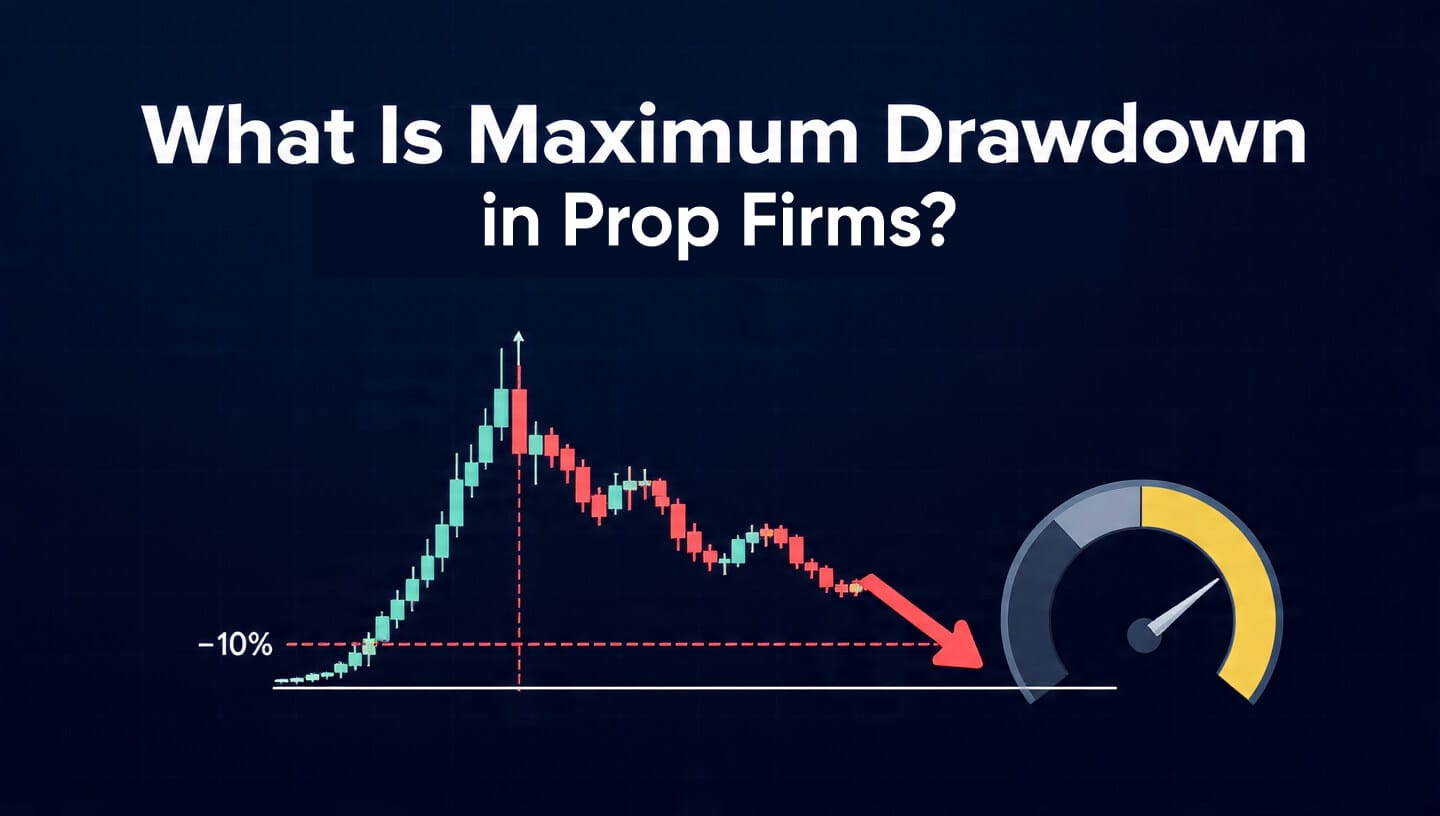
Maximum drawdown is the largest amount your account is allowed to lose before the challenge or funded account is considered failed.
Think of it as your account's safety limit.
Once your account equity or balance falls beyond the permitted drawdown threshold, you've broken one of the prop firm's most important risk management rules.
At that point, the account is typically closed, regardless of whether you might have recovered later.
Why Do Prop Firms Use Maximum Drawdown?
Prop firms manage significant amounts of trading capital.
Their goal isn't simply to find traders who can make profits—it is to find traders who can manage risk responsibly.
Maximum drawdown helps firms identify traders who:
- Control risk effectively
- Avoid reckless trading
- Preserve capital
- Demonstrate discipline
- Trade consistently
In other words, drawdown rules help protect both the firm's capital and the trader's long-term success.
Maximum Drawdown vs Daily Drawdown
Many beginners confuse these two rules.
They are related, but they measure different things.
Maximum Drawdown
This represents the total amount your account is allowed to decline over the life of the evaluation or funded account.
It is your overall loss limit.
Daily Drawdown
This limits how much your account can lose within a single trading day.
Even if you're comfortably within the overall maximum drawdown, exceeding the daily limit can still result in a failed account.
Understanding both rules is essential because violating either one can end your challenge.
Example of Maximum Drawdown
Imagine you purchase a challenge with a $100,000 account.
If the firm's maximum drawdown limit is 10%, your account generally cannot fall below $90,000, subject to the firm's specific drawdown calculation method.
If your losses push the account beyond that limit, the challenge fails.
The exact calculation varies between firms, so always review the current rules before trading.
Types of Maximum Drawdown
Different prop firms calculate drawdown differently.
Common approaches include:
- Static Drawdown: The drawdown limit remains fixed throughout the challenge. Your loss threshold does not move even if your account grows.
- Trailing Drawdown: The drawdown threshold can move upward as your account reaches new highs. This means your allowable loss limit may change during the evaluation. Understanding how trailing drawdown works is especially important because it requires different risk management.
- Balance-Based Drawdown: Some firms calculate drawdown using your account balance. Open trades may not immediately affect the calculation until they are closed.
- Equity-Based Drawdown: Other firms calculate drawdown using account equity. In this case, unrealized losses on open positions can contribute to a rule violation. Knowing whether your prop firm uses balance or equity calculations can significantly affect how you manage open trades.
Why Traders Violate Maximum Drawdown
Most drawdown violations occur because of poor risk management rather than poor trading strategies.
Common reasons include:
- Risking Too Much Per Trade: Large position sizes increase the likelihood of significant losses.
- Revenge Trading: Trying to recover losses quickly often leads to even larger losses.
- Overtrading: Taking unnecessary trades exposes your account to avoidable risk.
- Ignoring Stop Losses: Failing to define an exit point can allow small losses to become much larger ones.
- Trading Emotionally: Fear, greed, and frustration often lead to decisions that ignore established risk limits.
How to Avoid Maximum Drawdown Violations
Fortunately, there are practical ways to reduce your risk.
- Risk a Small Percentage Per Trade: Many disciplined traders risk only a small portion of their account on any single position.
- Always Use Stop Losses: Every trade should include a predetermined exit point.
- Follow Your Trading Plan: A written plan reduces emotional decision-making.
- Monitor Account Performance: Track your account regularly rather than waiting until you're close to the drawdown limit.
- Avoid Chasing Losses: Accept that losses are part of trading. Trying to recover quickly often makes the situation worse.
Does Maximum Drawdown Reset?
This depends entirely on the prop firm.
Some firms use fixed drawdown rules throughout the evaluation.
Others apply different drawdown methods after funding.
Because policies vary, always review the firm's latest documentation before purchasing a challenge or trading a funded account.
Why Maximum Drawdown Is More Important Than Profit Targets
Many new traders focus entirely on reaching the profit target.
Professional traders often focus on something different:
Protecting the account.
A trader who consistently preserves capital is far more likely to complete an evaluation than one who constantly takes excessive risks.
Profit opportunities will always come.
Capital, however, must first be protected.
How Professional Challenge Managers Handle Drawdown
Professional challenge managers typically approach drawdown conservatively.
Their priorities include:
- Strict position sizing
- Controlled risk exposure
- Rule compliance
- Capital preservation
- Consistent execution
Rather than chasing rapid profits, they focus on maintaining the account within the firm's risk limits throughout the evaluation.
Final Thoughts
Maximum drawdown is one of the most important rules in any prop firm challenge.
Understanding how it works—and managing your trades accordingly—can make the difference between passing an evaluation and losing your account.
Rather than focusing only on profit targets, successful traders prioritize protecting their capital, respecting risk limits, and following a disciplined trading process.
If you're preparing for a prop firm challenge and want experienced support, Funded Traders Passing offers professional challenge passing services that emphasize responsible risk management, strict rule compliance, and transparent communication throughout the evaluation process.
Frequently Asked Questions
What is maximum drawdown in a prop firm?
Maximum drawdown is the largest permitted decline in your account before the challenge or funded account is considered failed.
Is maximum drawdown the same as daily drawdown?
No. Maximum drawdown applies to the overall account, while daily drawdown limits losses within a single trading day.
Can I recover after exceeding maximum drawdown?
Generally, no. Once the maximum drawdown rule has been breached, the account is usually considered failed under the firm's terms.
Do all prop firms calculate drawdown the same way?
No. Some use static drawdown, others use trailing drawdown, while calculations may be based on balance or equity.
What is the best way to avoid maximum drawdown?
The most effective approach is disciplined risk management, including appropriate position sizing, stop-loss usage, and following a consistent trading plan.