
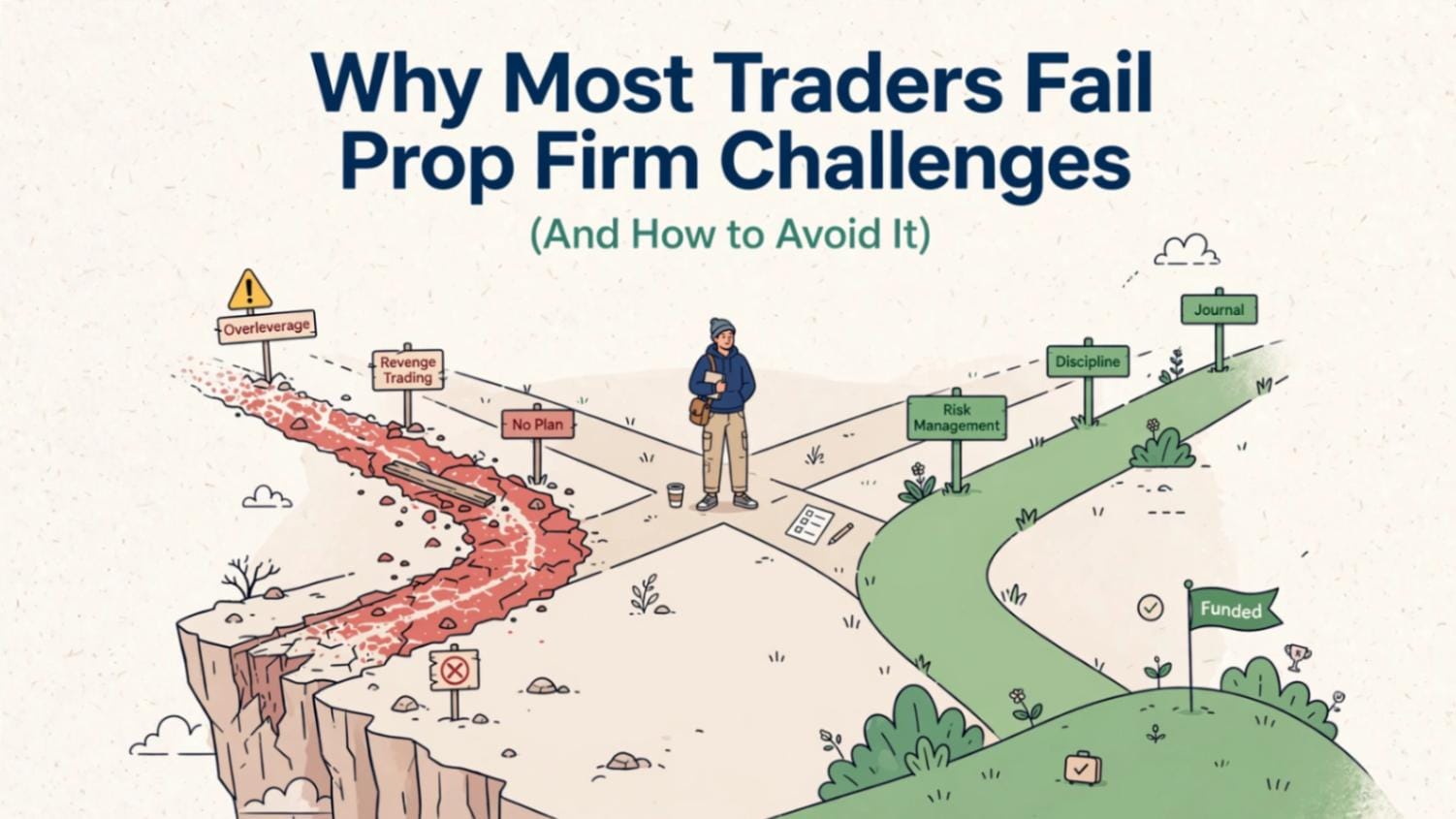
Every year, thousands of traders purchase prop firm challenges with the dream of accessing funded accounts worth tens or even hundreds of thousands of dollars. The opportunity is attractive: trade with a firm's capital, keep a share of the profits, and scale your account over time.
However, the reality is that a large percentage of traders never make it past the evaluation stage.
Some fail within a few days. Others come close to passing but violate a rule at the last moment. Many traders repeatedly purchase challenges only to experience the same disappointing result.
So why do most traders fail prop firm challenges?
The answer usually isn't a lack of trading knowledge. In many cases, traders fail because of poor risk management, emotional decision-making, unrealistic expectations, and a lack of consistency.
In this guide, we'll explore the most common reasons traders fail prop firm challenges and explain how you can avoid making the same mistakes.
Understanding the Purpose of a Prop Firm Challenge
Before discussing why traders fail, it's important to understand what prop firms are actually evaluating.
Many traders believe the challenge is simply about making profits.
In reality, prop firms are looking for traders who can:
- Manage risk effectively
- Follow rules consistently
- Protect capital
- Demonstrate discipline
- Produce sustainable results
A trader who earns 20% while taking reckless risks may be less attractive to a prop firm than a trader who earns 8% with strong risk management.
The evaluation process is designed to identify consistency, not gambling.
10 Reasons Why Most Traders Fail Prop Firm Challenges
1. Poor Risk Management
This is the biggest reason most traders fail.
Many traders focus exclusively on profit targets while ignoring the importance of protecting their accounts.
Common risk management mistakes include:
- Risking too much per trade
- Increasing position sizes after losses
- Trading without stop losses
- Ignoring drawdown limits
- Holding losing positions too long
How to Avoid It
Develop a risk management plan before entering any trade.
Consider:
- Setting a maximum risk per trade
- Respecting daily loss limits
- Using stop losses consistently
- Avoiding oversized positions
Successful traders focus on preserving capital first and generating profits second.
2. Emotional Trading
Even traders with profitable strategies can fail because of emotions.
Common emotional behaviors include:
- Revenge Trading: Trying to immediately recover losses often leads to larger losses.
- Fear of Missing Out (FOMO): Entering trades late because others appear to be profiting.
- Greed: Taking unnecessary risks in pursuit of faster profits.
- Fear: Closing winning trades too early because of uncertainty.
How to Avoid It
Create clear trading rules and follow them consistently.
Remember:
- Not every opportunity needs to be traded.
- Losses are part of trading.
- Patience often produces better results than impulsive decisions.
3. Overtrading
Many traders believe that taking more trades will increase their chances of reaching the profit target.
In reality, overtrading often increases exposure to unnecessary risk.
Signs of overtrading include:
- Trading out of boredom
- Entering low-quality setups
- Trading every market movement
- Increasing trade frequency after losses
How to Avoid It
Focus on quality over quantity.
Only take trades that meet your predefined criteria.
One good trade is often worth more than ten poor trades.
4. Chasing the Profit Target
One of the biggest mistakes challenge participants make is becoming obsessed with the target.
When traders focus solely on hitting a 10% target, they often:
- Increase position sizes
- Ignore risk management
- Enter low-probability trades
- Force trades that don't exist
Ironically, the harder traders chase the target, the more likely they are to fail.
How to Avoid It
Focus on executing your trading plan correctly.
If you consistently follow your strategy, profits are more likely to follow naturally.
5. Lack of a Proven Trading Strategy
Some traders purchase challenges before thoroughly testing their trading systems.
Without a proven strategy, results become inconsistent.
Warning Signs
- Constantly changing strategies
- Switching indicators every week
- Trading based on social media opinions
- Entering trades without clear reasoning
How to Avoid It
Before purchasing a challenge:
- Backtest your strategy
- Forward test on demo accounts
- Track your results
- Understand your statistical edge
Consistency comes from confidence in your process.
6. Ignoring Challenge Rules
Many traders fail challenges despite being profitable.
Why?
Because they violate challenge rules.
Examples include:
- Exceeding daily drawdown limits
- Breaching maximum loss limits
- Holding prohibited positions
- Violating consistency requirements
How to Avoid It
Read and understand every challenge rule before placing your first trade.
Many traders spend more time analyzing charts than reviewing challenge requirements.
7. Lack of Patience
Modern traders often want instant results.
When a challenge doesn't progress quickly enough, frustration sets in.
This often leads to:
- Overtrading
- Aggressive risk-taking
- Poor decision-making
How to Avoid It
Accept that passing a challenge is a process.
Professional traders focus on consistency rather than speed.
Patience is a competitive advantage.
8. Trading Without a Plan
Entering the market without a structured plan is one of the fastest ways to fail.
A proper trading plan should define:
- Entry criteria
- Exit criteria
- Risk management rules
- Position sizing
- Daily trading limits
Without a plan, decisions become emotional and inconsistent.
How to Avoid It
Document your trading process and follow it consistently.
Your plan should guide your decisions—not your emotions.
9. Unrealistic Expectations
Many traders believe they can double an account within days.
These unrealistic expectations create pressure and encourage excessive risk-taking.
How to Avoid It
Approach challenges with realistic goals.
The objective is not to get rich quickly.
The objective is to demonstrate that you can manage capital responsibly.
10. Lack of Consistency
Ultimately, consistency is what prop firms value most.
A trader who follows a process repeatedly is more likely to succeed than a trader who occasionally produces spectacular results.
Consistency includes:
- Following rules
- Managing risk
- Controlling emotions
- Executing strategies correctly
Prop firms fund consistency—not luck.
What Successful Traders Do Differently
Successful challenge participants typically:
- Prioritize risk management
- Trade patiently
- Follow a proven strategy
- Respect challenge rules
- Focus on consistency
- Avoid emotional decisions
- Maintain realistic expectations
These habits significantly improve long-term performance.
What If You've Failed Multiple Challenges?
If you've failed multiple evaluations, you're not alone.
Many profitable traders have experienced challenge failures.
The key is identifying the root cause.
Ask yourself:
- Was risk management the issue?
- Were emotions affecting decisions?
- Did I follow my trading plan?
- Did I fully understand the challenge rules?
Learning from previous failures can dramatically improve future performance.
How Professional Challenge Passing Services Help
Some traders choose to work with professional challenge passing services after experiencing repeated failures.
These services help by:
- Applying disciplined risk management
- Following challenge requirements carefully
- Eliminating emotional trading
- Leveraging professional trading experience
For traders who lack time, consistency, or confidence, professional assistance can provide an alternative path toward funding.
Frequently Asked Questions
Why do most traders fail prop firm challenges?
The most common reasons include poor risk management, emotional trading, overtrading, lack of discipline, and failure to follow challenge rules.
What is the biggest mistake traders make?
Risking too much in an attempt to reach profit targets quickly is one of the most common mistakes.
Can a profitable trader still fail a challenge?
Yes. A trader can generate profits and still fail by violating challenge rules or exceeding drawdown limits.
How can I improve my chances of passing?
Focus on risk management, consistency, discipline, and following a proven strategy.
Should I use a challenge passing service?
Some traders choose professional assistance after multiple failed attempts or when they lack the time to trade actively. Learn about the best passing services.
Final Thoughts
Most prop firm challenge failures are not caused by a lack of market knowledge. Instead, they result from poor risk management, emotional decision-making, overtrading, and inconsistent execution.
The good news is that these mistakes can be corrected.
By focusing on discipline, consistency, patience, and proper risk management, traders can significantly improve their chances of passing prop firm evaluations and securing funded accounts.
Whether you choose to trade the challenge yourself or seek professional assistance, understanding why traders fail is the first step toward becoming one of the traders who succeed.